Stop Relying on Engagement Surveys. They Are Not Psychosocial Risk Assessments.
The Comfortable Mistake Employers Keep Making
Across Australia, employers of every size are making the same mistake. They assume that because they run an annual engagement or employee experience survey, they are meeting their WHS duty to manage psychosocial risk. The numbers look encouraging, the dashboard glows green, and the board feels reassured. It is an understandable conclusion, and it is also a dangerous one.
At the Psychosocial Safety and Leadership Institute, we see the consequences of this misunderstanding weekly. Injuries that appeared to come out of nowhere. Claims that did not match the story the engagement data had been telling. Leaders confused about how a team that rated their workplace as a good place to work could still be wrestling with burnout, conflict, or breakdowns in psychological health.
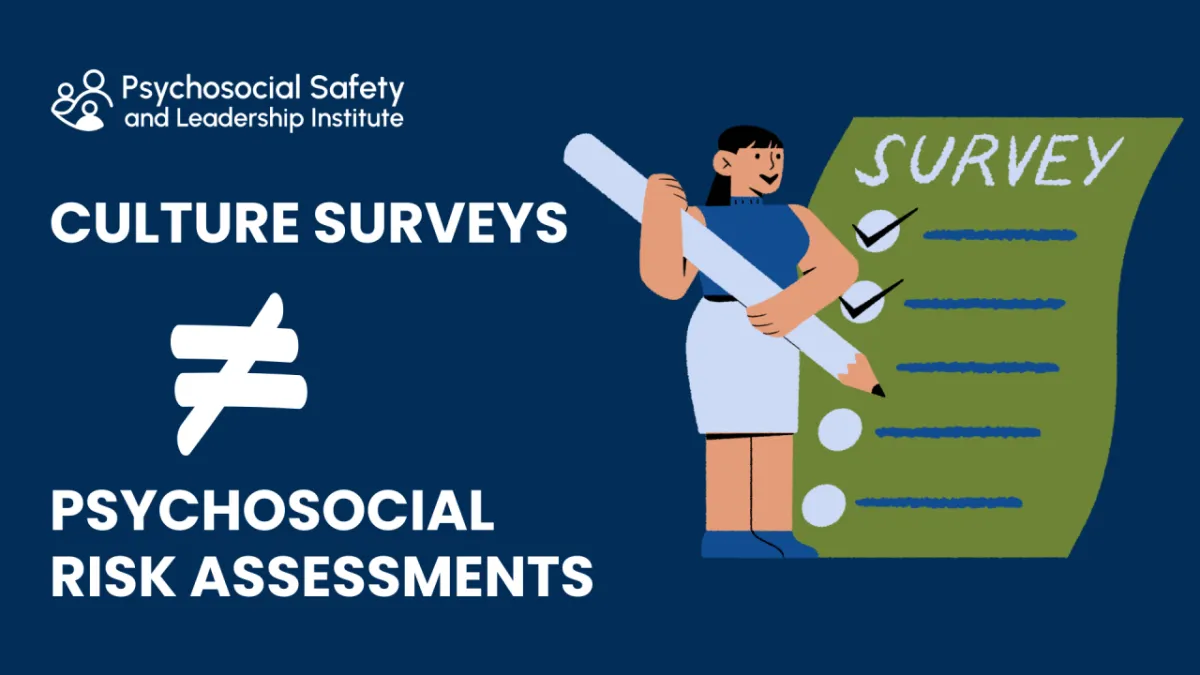
There is a simple reason for this mismatch. Engagement surveys measure how people feel about work. Psychosocial risk assessments measure what in the system of work causes harm. These are not the same thing, and confusing them creates blind spots that leave organisations exposed.
Emotion tells you the weather. Hazards define the climate. You cannot assess climate from a single sunny day.
What PMES and Engagement Surveys Really Are
To understand the gap, we must first understand the purpose of the tools many employers rely upon. One of the most well known is the People Matter Employee Survey (PMES), widely used across the NSW public sector.
The NSW Public Service Commission describes PMES as the annual survey that asks public sector employees about their experience and perceptions of workplace practices, including leadership, service delivery, engagement, diversity, inclusion, public sector values, and unacceptable conduct. This definition is unambiguous. PMES is an employee opinion and experience survey. It measures perceptions, satisfaction, values alignment and cultural sentiment.
These are important insights. They help organisations understand tone and climate. They tell a story about leadership behaviour and how people interpret the workplace around them. What they do not do is measure job demands, control, role clarity, workload strain, organisational justice, trauma exposure, bullying as a risk category, or any of the psychosocial hazards identified in the Model Code of Practice.
If employers use PMES as though it were a WHS risk tool, they unintentionally replace hazard assessment with sentiment analysis. And while people’s experiences matter, psychosocial risk assessment requires something different: evidence about the conditions of work that create harm.
PMES is designed to understand experience, not hazard. It is a valuable culture tool, but it cannot replace a psychosocial risk assessment because it was never built for that purpose.
What WHS Law Actually Requires
The obligations under WHS legislation are clear. Safe Work Australia defines psychosocial hazards as anything in the design or management of work that increases the risk of work related stress. The Model Code of Practice specifies that employers must identify psychosocial hazards, assess the associated risks, implement measures to eliminate or minimise those risks, and then review the effectiveness of those measures.
This means an employer must be able to demonstrate that they have examined the system of work with the intention of identifying conditions that have the potential to cause physical or psychological harm. It is not enough to ask whether people feel valued or supported in general. A risk assessment is not a popularity measure. It is a technical process that requires valid data about system behaviours that elevate risk.
Safe Work Australia’s systematic guidance on psychological health is even more explicit. If a survey is used to support hazard identification or risk assessment, the tool must be reliable and valid. In other words, the instrument must measure what it claims to measure, and it must do so consistently. This is the foundation of defensible WHS practice.
Psychosocial risk assessment is a regulated process that focuses on hazards and risk. Any tool used must be valid, reliable and linked to control decisions. Engagement surveys do not meet that threshold.
Psychosocial Risk Is About the System, Not the Person
This is one of the most important distinctions employers need to understand. Psychosocial risk is not about how people feel about work in general. It is about the conditions of work that create harm, regardless of whether people feel positive or negative about their job.
Safe Work Australia defines psychosocial hazards as features of work design or management. This definition makes it clear that psychosocial safety is a property of the system of work. It is not a property of the worker.
Engagement surveys ask questions about an individual’s emotional or attitudinal experience. These include whether they feel valued, whether they recommend the organisation, whether they feel proud to work there, or whether they feel a sense of belonging. These items capture sentiment but they do not measure hazard exposure. They tell us how people feel within the system but not how the system is affecting them.
Research has shown for decades that workers can feel engaged, motivated and committed while still being exposed to harmful conditions. High job demands, low role clarity, inconsistent supervision, organisational injustice and emotional labour can all coexist with high engagement. Feelings fluctuate quickly, but hazard exposure remains present until the system is changed.
When employers rely on engagement data to understand psychosocial safety, they assess the emotional weather rather than the structural climate. The emotional weather might be pleasant on the day of the survey, but the climate may still be harmful.
Psychosocial risk comes from the system, not the person. Engagement surveys reveal feelings, not hazards. WHS risk assessment requires system level analysis.
What Validated Psychosocial Risk Tools Do Differently
Validated psychosocial instruments such as the Copenhagen Psychosocial Questionnaire (COPSOQ) and the Psychosocial Safety Climate (PSC) scale are constructed to measure hazard exposure. They are grounded in decades of occupational health psychology research that links specific work conditions to psychological and physical harm.
The science is substantial. PSC has been shown to predict job demands, burnout and psychological distress across multiple industries. COPSOQ has been validated internationally and more recently within Australian working populations, demonstrating strong reliability and validity across hazard domains. Job demands, control, fairness, role clarity and supervisor support have been consistently identified as predictors of harm.
These validated tools measure aspects of the system of work that elevate risk. They assess the sources of pressure, conflict or overload that create injury pathways. Their outputs can be translated into risk levels that inform control priorities. In short, they help employers meet both the scientific and regulatory standards required for psychosocial hazard management.
Engagement measures cannot do this because they are not built on hazard constructs. They are designed to reveal attitudes. They are not designed to reveal risk.
Validated tools measure hazards, predict outcomes and guide controls. Engagement tools measure sentiment, which cannot serve as a proxy for risk.
The Psychosocial Safety and Leadership Institute Defensibility Test
Because The Psychosocial Safety and Leadership Institute functions as Australia’s peak body for psychosocial risk, we offer employers a clear defensibility test. If your current survey were reviewed by a regulator, investigator or court, would it hold up as a psychosocial risk assessment?
To be defensible, your survey must measure recognised hazards, demonstrate validity and reliability, produce interpretable risk levels, link to control measures, and be embedded in an ongoing risk management cycle. If it does not meet these criteria, it is a culture tool, not a WHS tool.
Employers must be confident that their method stands up to scrutiny. A high engagement score may be encouraging, but it does not eliminate hazard exposure or fulfil WHS obligations.
If a survey cannot support hazard identification, risk assessment and control decisions, it is not defensible as a WHS tool. Every PCBU should be able to explain why their measurement approach is valid.
Executive Brief
For senior leaders, the message is simple.
Engagement surveys measure perception, not hazard.
Psychosocial risk assessment requires valid, reliable, hazard aligned tools.
WHS law requires hazard identification, risk assessment, controls and review.
Culture tools complement risk assessment but cannot replace it.
Using the wrong tool creates compliance gaps and operational blind spots.
If you want to manage psychosocial safety, you must measure risk, not mood.
Closing Message from The Psychosocial Safety and Leadership Institute
Good employers want to do the right thing. The challenge is not intent. It is the method. Engagement surveys are familiar, accessible and often mandated for culture reporting. But psychosocial safety is a different domain with different requirements.
As Australia’s peak body, The Psychosocial Safety and Leadership Institute encourages every organisation to take a closer look at the tools they use. If a survey measures attitudes, you will understand culture. If a survey measures hazards, you will understand risk. Your people need you to understand both, but WHS law requires you to act on the second.
The Psychosocial Safety and Leadership Institute is available to support organisations in refining their measurement systems, building defensible methodologies and strengthening their approach to psychosocial risk.
Contact is at [email protected]