What psychosocial risk data may be telling us about the changing nature of work
Australia’s workforce data is pointing to a broader systems issue
A recent ABC News article examining Australia’s growing reliance on income support systems following illness and injury highlighted a trend that many employers, insurers and regulators have been observing for some time. Mental health conditions are now playing an increasingly significant role in long-term workforce participation, with growing concern regarding the social and economic implications of psychological injury, prolonged incapacity and workforce disengagement (ABC News, 2026).
At face value, these discussions are often framed as evidence of a worsening “mental health crisis.” While mental health is undoubtedly part of the picture, framing the issue solely through an individual psychological lens risks oversimplifying a much broader systems problem emerging within modern work itself.
Over the past decade, Australian workplaces have become substantially more psychologically literate. Organisations have invested heavily in wellbeing programs, resilience initiatives, mental health first aid training, awareness campaigns and employee assistance programs. Simultaneously, psychosocial hazards have become increasingly embedded within Australian work health and safety discourse, with regulators placing greater emphasis on the management of psychosocial risk as part of standard WHS obligations.
Despite this increased awareness, however, psychological injury claims continue to rise, claim durations remain significantly longer than physical injuries, and workforce exhaustion is increasingly being normalised across multiple sectors. This raises an important question. If organisational awareness of mental health has improved so substantially, why do indicators of psychosocial strain continue to intensify?
Part of the answer may lie in the fact that many organisations are still conceptualising psychosocial harm as an issue of individual coping capacity rather than examining the cumulative operational conditions shaping human functioning over time.
High-performing workplaces are not necessarily low-risk workplaces
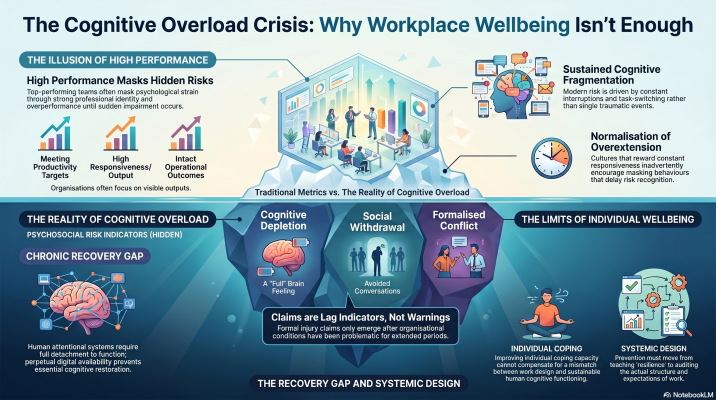
Across quantitative and qualitative psychosocial risk datasets collected by the Psychosocial Safety and Leadership Institute, several themes have emerged consistently across sectors including healthcare, legal services, emergency response, disability, aged care and government environments. Importantly, these themes are not confined to organisations experiencing obvious dysfunction or operational instability. In many cases, elevated psychosocial strain is appearing inside organisations that continue to perform strongly according to traditional operational metrics.
This distinction is important because it challenges one of the most persistent assumptions in organisational risk management - namely, that psychosocial harm will necessarily become visible through obvious underperformance before significant workforce impairment occurs.
Increasingly, the opposite appears to be true.
Some of the highest psychosocial risks are emerging within environments characterised by high conscientiousness, strong professional identity and sustained overperformance. In these settings, workers frequently continue functioning at a high level despite escalating cognitive and emotional fatigue because professional competence itself becomes tied to responsiveness, endurance and emotional containment. Operational success can therefore coexist with significant psychosocial strain for prolonged periods of time.
Cognitive overload may now be one of the defining risks of modern work
Within qualitative workforce responses, workers frequently describe environments characterised not simply by “high workload,” but by sustained cognitive fragmentation. Employees report constant interruption cycles, competing priorities, rapid task-switching, escalating administrative complexity and reduced opportunity for uninterrupted concentration or psychological detachment from work demands. The issue, in many cases, is not one singular excessive demand. Rather, it is the cumulative cognitive effect of continuous responsiveness without adequate recovery.
Contemporary psychosocial risk may increasingly be driven less by isolated traumatic events and more by chronic disruption to recovery capacity itself.
Occupational health literature has consistently demonstrated the importance of psychological detachment and recovery in maintaining cognitive functioning, emotional regulation and sustainable work engagement (Sonnentag & Fritz, 2015). Human attentional systems are not designed for perpetual activation. Yet many modern workplaces now operate in ways that require workers to remain cognitively available across prolonged periods with limited opportunity for restoration. Emails, messaging platforms, compliance obligations, emotional interactions, meetings and ongoing performance demands combine to create environments in which workers rarely achieve full cognitive disengagement from work itself.
Importantly, workers do not always describe these experiences using traditional burnout language. Across qualitative psychosocial datasets, many employees instead describe feeling mentally “full,” unable to complete meaningful work despite constant activity, cognitively depleted at the end of the day, or persistently unable to mentally switch off outside working hours. These observations align with broader research suggesting that emotional exhaustion and disengagement are strongly associated with sustained job demands, reduced recovery opportunity and prolonged attentional strain (Bakker & Demerouti, 2007; Crawford et al., 2010).
When chronic overload becomes culturally normalised
One of the more concerning patterns emerging across psychosocial risk assessment work is the extent to which chronic overload appears to have become culturally normalised within some industries;
Workers who remain highly responsive under pressure are often rewarded organisationally.
Leaders who absorb escalating emotional and operational demands without complaint are frequently perceived as capable and resilient.
Teams that continue delivering despite resource strain are viewed positively because operational outcomes remain intact.
However, from a psychosocial safety perspective, these same behaviours may also function as masking mechanisms that delay organisational recognition of risk.
This is one reason psychological injury claims should be understood primarily as lag indicators rather than early warning signs. By the time formal claims emerge, the organisational conditions contributing to impairment have often been operating for extended periods. In many cases, earlier indicators of strain appear behaviourally rather than procedurally:
Workers stop speaking openly.
Leaders avoid difficult conversations.
Teams become socially withdrawn.
Conflict becomes increasingly formalised.
Psychological safety deteriorates quietly before operational metrics visibly shift.
This creates a significant challenge for organisations because traditional organisational performance indicators do not necessarily measure workforce sustainability effectively. A team may continue meeting productivity targets while simultaneously experiencing escalating cognitive overload, emotional fatigue and reduced recovery capacity. The operational system can therefore appear stable while underlying workforce resilience deteriorates progressively over time.
Why prevention must move beyond wellbeing rhetoric
From a prevention perspective, this has important implications for how psychosocial risk is conceptualised organisationally. Many workplaces continue to frame prevention predominantly through individual wellbeing interventions aimed at improving worker resilience or psychological coping. While these initiatives may provide benefit, they do not address the underlying structural and operational conditions contributing to psychosocial strain in the first place.
The evidence base surrounding psychosocial hazards is now extensive. Safe Work Australia (2024) identifies factors such as high job demands, low support, poor organisational change management, low role clarity and inadequate reward and recognition as significant psychosocial risks associated with workplace harm. Similarly, the Productivity Commission’s Mental Health Inquiry (2020) highlighted the substantial economic and workforce participation consequences associated with mentally unhealthy workplaces across Australia.
The challenge for many organisations is that psychosocial risk management requires examination not only of individual worker behaviour, but of the design, structure and operational expectations of work itself. This includes considering whether workloads are sustainable, whether communication systems are cognitively manageable, whether workers have sufficient autonomy and recovery opportunity, and whether leadership structures are adequately equipped to manage the relational complexity increasingly embedded within modern work environments.
Australia’s psychological injury trends may reflect a changing relationship with work itself
At a broader societal level, Australia’s growing psychological injury burden may therefore represent more than an individual mental health issue alone. It may also reflect an emerging mismatch between contemporary work design and sustainable human cognitive functioning.
This becomes particularly significant within the context of an ageing workforce, increasing labour shortages and growing concerns regarding long-term workforce participation. When large numbers of workers disengage from employment due to psychological injury, chronic exhaustion or reduced work capacity, the consequences extend well beyond individual organisations into healthcare systems, insurer costs, productivity, leadership capability and national economic participation more broadly.
Importantly, none of this suggests that modern work should be pressure-free. Many industries represented within psychosocial datasets involve genuine operational complexity, emotional labour and high public responsibility. Pressure itself is not inherently harmful. However, there is a substantial difference between sustainable high performance and chronic organisational overextension.
Sustainable performance allows for recovery, adaptability, communication and psychological safety under pressure. Chronic overextension, by contrast, relies increasingly on workers absorbing escalating strain in ways that may not become operationally visible until workforce capability has already begun to deteriorate.
The increasing reliance on income support systems for psychological conditions may therefore be signalling something important about the changing nature of work in Australia. Not simply that more individuals are struggling psychologically, but that many workplaces may now be operating in ways that are becoming progressively harder for human beings to sustainably recover from over time.