Why Technical Brilliance Can Become a Psychosocial Risk
Under Australian work health and safety law, managers are responsible for designing safe and sustainable systems of work. Their role is not simply to encourage employees to endure pressure or push harder when workloads increase.
This distinction is fundamental.
When workloads are excessive, roles unclear, or interpersonal behaviour left unmanaged, these conditions are no longer simply organisational frustrations. Under the Work Health and Safety framework they are recognised as psychosocial hazards. Like any other workplace hazard, they must be identified, assessed and controlled so far as is reasonably practicable (Safe Work Australia, 2022).
Yet many organisations still promote leaders using a model that predates this shift in regulation.
Across industries such as engineering, medicine, mining and law, leadership positions are frequently awarded to individuals who demonstrate exceptional technical competence. The best engineer becomes the Engineering Manager. The most productive lawyer becomes the Senior Partner. The clinician with the strongest reputation becomes the Head of Unit.
At first glance this approach appears sensible. Organisations reward excellence and assume that technical mastery will naturally translate into leadership capability.
In practice these are very different skill sets.
Technical expertise focuses on solving problems within a professional discipline. Leadership, particularly under modern WHS expectations, involves something quite different. It requires designing and regulating the environment in which other people perform their work.
When organisations promote technical experts without preparing them for this responsibility, they often create what might be described as the Accidental Manager.
The Accidental Manager is rarely incompetent or malicious. In fact they are often among the most capable professionals in the organisation. The challenge is that the behaviours which made them successful as an individual contributor do not automatically translate into effective leadership.
Relentless focus, high personal standards and a strong bias towards solving problems through effort can be extremely valuable traits in technical roles. Applied to the management of people without the right framework, those same traits can unintentionally generate psychosocial risk.
The Expertise Trap
Technical specialists typically build their careers through individual mastery. Their professional identity is often tied to their ability to solve difficult problems and deliver complex outcomes.
Because of this, when work begins to fall behind schedule the instinctive response is often straightforward. Work harder. Push through. Ask the team to dig deep.
For individuals this approach can be effective. For teams operating within complex organisational systems it can create significant problems.
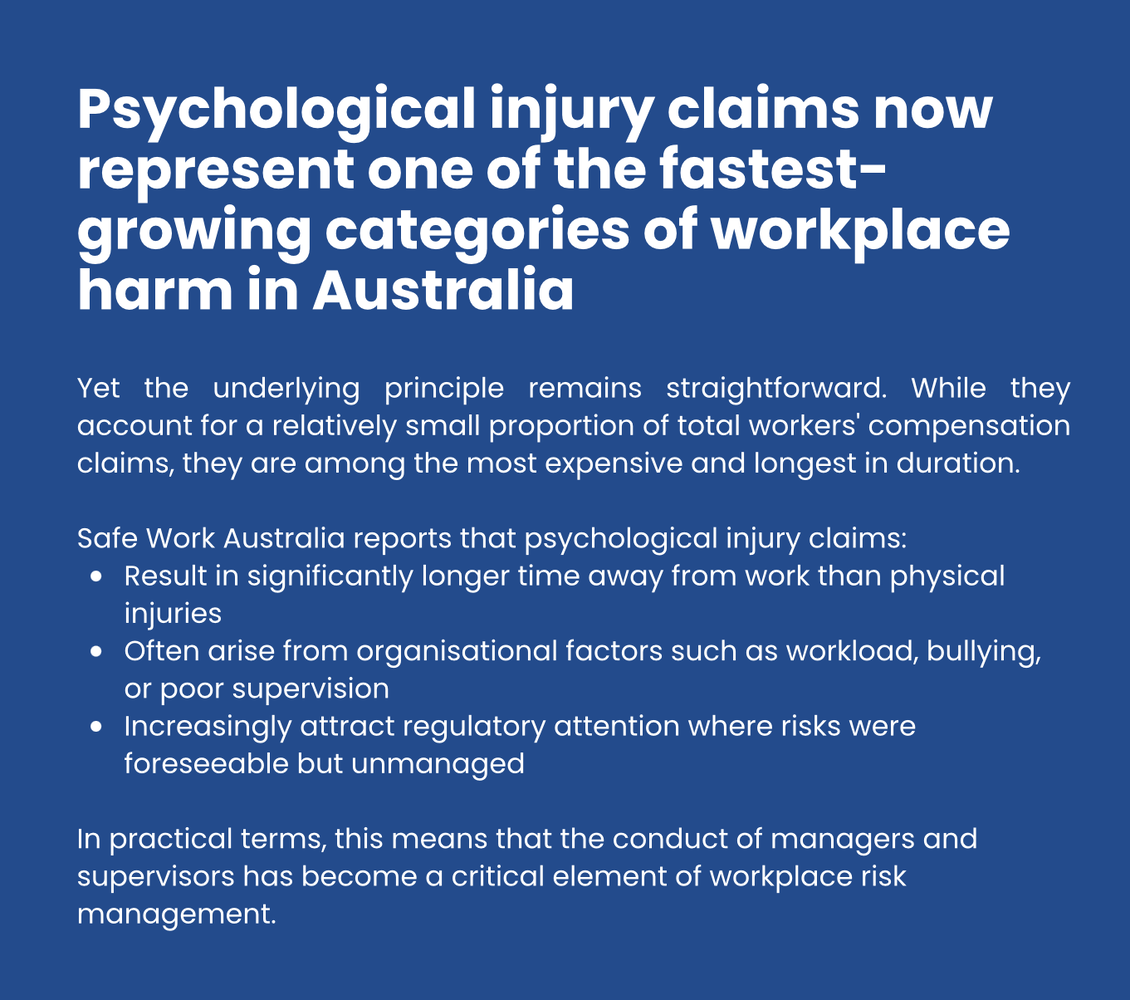
The WHS framework does not interpret persistent overload as a sign of commitment. Instead it is treated as a potential indicator that the system of work itself may be poorly designed.
Occupational health research has consistently demonstrated that high job demands combined with insufficient organisational resources significantly increase the likelihood of burnout and psychological strain (Bakker & Demerouti, 2017). What appears on the surface to be a performance issue may in fact reflect structural features of the work environment.
This is the point where the role of the manager changes.
They are no longer responsible primarily for completing the work themselves. Their responsibility is to ensure that the system in which the work occurs is safe, sustainable and professionally regulated.
Leadership as System Design
Once this shift is understood, leadership begins to look less like a personality trait and more like a system design function.
Managers shape several elements of the work environment that directly influence psychological health. These include how workloads are allocated, whether roles are clearly defined, how decisions are communicated and how interpersonal behaviour is regulated.
Each of these factors contributes to what organisational psychologists describe as Psychosocial Safety Climate.
Psychosocial Safety Climate refers to employees’ shared perceptions about whether management genuinely prioritises psychological health and safety alongside productivity (Dollard & Bakker, 2010).
Where this climate is strong, employees experience lower job strain and higher engagement. Where it is weak, organisations often see higher levels of burnout, turnover and workplace conflict.
Importantly, Psychosocial Safety Climate is not created through policies alone. It is created through the everyday behaviour of leaders.
Every decision about workload allocation, meeting behaviour or conflict management communicates something to employees about whether safety genuinely matters.
Australian Case Context
Recent inquiries across Australian sectors have highlighted the consequences of poorly managed psychosocial risk.
Investigations into workplace cultures within universities, mining operations and professional services firms have repeatedly identified similar patterns. High performance expectations combined with weak supervision of interpersonal conduct created environments where bullying, excessive workloads and psychological distress became normalised.
In several cases, employees had raised concerns informally long before formal investigations began.
These findings reinforce an important point. Psychosocial risk rarely appears suddenly. It develops gradually through everyday behaviours and decisions within teams.
When those signals are not addressed early, the issue can escalate into regulatory scrutiny, reputational damage and significant financial cost.
The Invisible Hazard: The Untouchable High Performer
One of the most difficult situations for newly promoted managers occurs when a technically exceptional employee demonstrates harmful interpersonal behaviour.
Most professional workplaces have some version of the individual whose technical output is highly valued but whose behaviour towards colleagues is dismissive, aggressive or undermining.
For an inexperienced manager, addressing this behaviour can feel risky. They may worry about losing the productivity of a high performer or disrupting a critical project.
Yet the research evidence is clear.
Workplace incivility and bullying are strongly associated with increased psychological distress, reduced job satisfaction and higher turnover intentions among affected employees (Schilpzand, De Pater, & Erez, 2016).
When organisations tolerate harmful behaviour because someone produces strong technical results, they unintentionally send a clear signal to the rest of the team. Performance is valued more highly than safety.
From a WHS perspective this represents a failure to manage a foreseeable hazard.
Leadership Self Check
Are You Managing the System or Just the Output?
Technical leaders can use the following questions as a quick reflection on how work is currently structured within their teams.
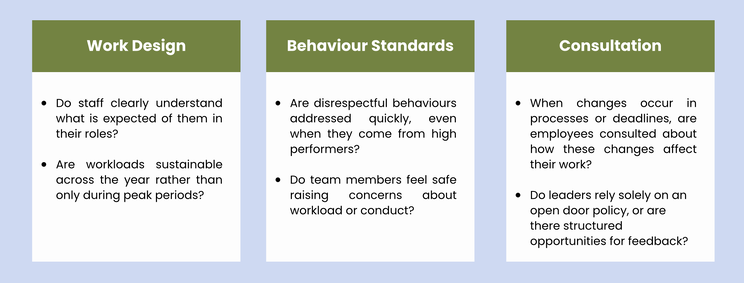
Where leaders struggle to answer these questions with confidence, it often signals an opportunity to strengthen the system of work.
The Shift from Technical Expert to Systems Leader
For technical professionals who move into leadership roles, the challenge is not abandoning their expertise. The challenge is expanding their focus.
Instead of concentrating solely on the technical content of the work, effective leaders begin to manage the context in which the work occurs.
This involves developing several new capabilities.
Leaders must understand the principles of work design. They need to consider whether expectations are realistic, whether staff have sufficient authority to meet their responsibilities and whether workloads are sustainable over time.
Leaders must regulate behaviour early. Small signals such as sarcasm, dismissive comments or exclusion from decision making often indicate emerging relational risks. Addressing these behaviours promptly prevents escalation.
Leaders must consult with their teams about how work is experienced in practice. Employees frequently remain silent about psychosocial concerns because they believe nothing will change or they fear professional consequences (Edmondson, 2019). Structured consultation processes help surface these risks before they escalate.
A Changing Leadership Landscape
The long standing assumption that technical brilliance naturally produces effective leadership is increasingly being challenged.
Modern workplaces require something different.
They require leaders who understand that their primary responsibility is not only to deliver outcomes but also to design environments where people can perform sustainably and safely.
Technical expertise remains valuable. However, when it is not supported by leadership capability it can unintentionally create risks that organisations are now legally required to manage.
For many professionals the transition from expert to leader is not automatic. It is a deliberate developmental step.
Recognising the difference between doing the work and designing the work is often the moment where the Accidental Manager begins to evolve into an effective leader.
References
Bakker, A. B., & Demerouti, E. (2017). Job demands resources theory: Taking stock and looking forward. Journal of Occupational Health Psychology, 22(3), 273–285.
Dollard, M. F., & Bakker, A. B. (2010). Psychosocial safety climate as a precursor to conducive work environments. Journal of Occupational and Organizational Psychology, 83(3), 579–599.
Edmondson, A. (2019).The fearless organization: Creating psychological safety in the workplace for learning, innovation, and growth. Wiley.
Montano, D., Reeske, A., Franke, F., & Hüffmeier, J. (2017). Leadership, followers’ mental health and job performance in organizations. Journal of Organizational Behavior, 38(3), 327–350.
Safe Work Australia. (2022).Model code of practice: Managing psychosocial hazards at work.
Schilpzand, P., De Pater, I., & Erez, A. (2016). Workplace incivility: A review of the literature and agenda for future research. Journal of Organizational Behavior, 37(S1), S57–S88.