The Governance Gap: Why Psychosocial Safety is the New Frontier of Australian WHS Liability
There is a moment that happens in almost every leadership session in Australia today.
The conversation is moving quickly. Operational issues are being worked through. Decisions are being made with confidence. Then someone introduces the topic of psychosocial safety.
And the room shifts.
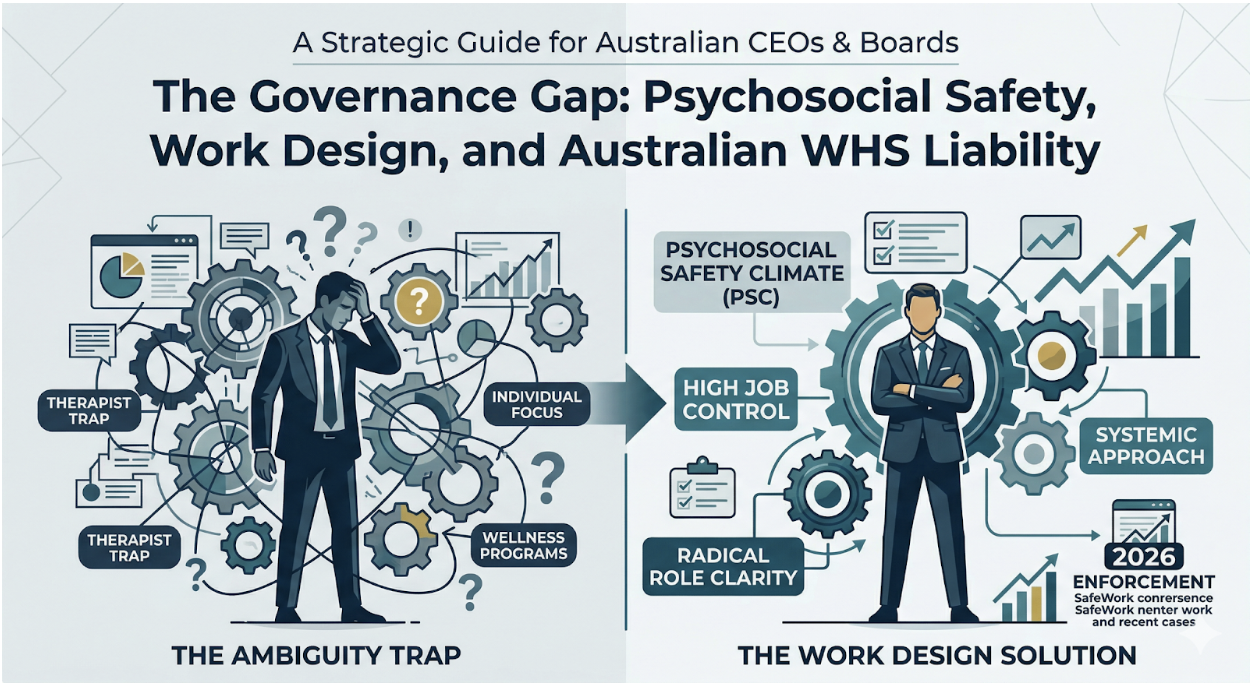
Not dramatically. No one objects. No one dismisses it. But the pace slows. The language becomes more cautious. Leaders who were decisive moments earlier begin to weigh their words more carefully. They are not resisting the concept; they are trying to solve for an Ambiguity Trap. When leaders are unclear about boundaries or consequences, their risk tolerance decreases (Tversky & Kahneman, 1974). They aren't stepping back because they don't care. They are stepping back because they cannot see where their responsibility ends and amateur therapy begins.
The New Reality: Case Studies in Enforcement
In 2026, the wait and see approach has become a significant liability. Two landmark cases have redefined what Reasonably Practicable looks like for Australian boards.
Case Study 1: The Williamtown Conviction (2025)
In a landmark penalty for a Commonwealth employer, the Department of Defencewas convicted and fined following the death of a worker at RAAF Base Williamtown. The court found that the department failed to manage the obvious and foreseeable risks associated with a relentless series of performance management plans. Supervisors were not trained to recognise the psychological strain caused by the performance process itself.
The Lesson: Performance management is not just an HR task - it is a high risk safety activity. If the process causes harm, the employer is liable, regardless of the worker's pre-existing resilience.
Case Study 2: The UTS Prohibition (2025)
SafeWork NSW made history by issuing a Prohibition Noticeto theUniversity of Technology Sydney (UTS), effectively halting a redundancy process. The Regulator intervened not because of the decision to cut roles, but because the method of communication (short timeframes and lack of consultation) created a serious and imminent risk of psychological harm.
The Lesson: Regulators now have the power to stop your business operations if your change management processes are deemed psychologically unsafe.
Moving to Action: The Executive Framework
To bridge the gap between taboo and task, leaders must move away from clinical language and toward Work Design.
1. From Mental Health to Work Friction
For decades, leaders have been told that psychological health is about the individual's mind. This makes psychosocial safety feel like a person problem. To fix this, you must shift the focus to Work Design. Psychosocial hazards like role ambiguity, low job control and effort-reward imbalance (Siegrist, 1996) are the result of how work is built, not who is doing it.
When you frame safety as Work Friction, it becomes an engineering problem. You are looking for the places where the gears of your organisation are grinding. This includes where people are doing stupid work, chasing unclear goals or working under constant, unmonitored pressure. This reframes the leader's role from counselor to systems architect.
By focusing on friction, you move the conversation away from the taboo of mental health and into the comfort zone of a CEO: operational efficiency. A system that creates psychological harm is, by definition, an inefficient system. Solving for safety is simultaneously solving for productivity.
What Next and How to Implement:
Audit the 'Stupid Work': Identify one process that everyone complains about but that's just how we do it. These are often latent psychosocial hazards.
Shift the Language: In your next meeting, replace the word stress with system pressure. Ask:Where is the system pressure highest today?
Use Data, Not Vibes: Stop relying on annual engagement surveys. Implement a monthly Pulse Check specifically focused on the hazards identified in the Safe Work Australia Code of Practice.
2. Radical Role Clarity and Decision Authority
Research shows that Low Job Control (having high demands but no power to influence how they are met) is one of the most toxic psychosocial hazards (Karasek, 1979). Leaders are often afraid that giving control means losing authority. In reality, it means giving staff the specific tools and permissions they need to resolve the friction they face daily.
The goal is to eliminate Cognitive Load caused by ambiguity. When a worker isn't sure if they have the authority to make a call, or who they report to for a specific task, their brain stays in a state of high alert. Over time, this sustained system pressure leads to burnout and injury.
Role clarity is the most under-utilised medicine in the corporate world. When expectations are crystal clear and the person has the authority to execute, the psychological load of the job drops significantly, even if the workload remains high.
What Next and How to Implement:
The 'Authority Audit': Have your direct reports list three decisions they feel they should be able to make but currently feel they can't.
Define 'Done' Clearly: For every major project, ensure the Definition of Success is documented in two sentences or less. Ambiguity is a hazard; clarity is a control.
Review Hierarchies: Ensure every person has one (and only one) person they are accountable to for a specific output. Dotted lines are psychosocial minefields.
3. Change Management as a Safety Protocol
As seen in the UTS case, the way you change is as important as the change itself. High functioning systems treat Organisational Change as a Category 1 hazard. This means you don't just announce a change; you risk assess the rollout. Effective change management is not about getting buy-in (which is a sales task); it is about consultation(which is a safety task).
Under WHS law, you have a mandatory duty to consult with workers who are affected by safety risks. This means giving them a genuine opportunity to influence the controls used to manage the stress of the transition. Failing to do so is no longer just poor management. It is a regulatory breach.
When change is managed through the lens of safety, it reduces the rumination and uncertainty that lead to psychological claims. You aren't just protecting people. You are protecting the viability of the project itself.
What Next and How to Implement:
Pre-Mortem Assessments: Before announcing a restructure or new tech rollout, hold a Pre-Mortem with a cross-section of staff. Ask:How could this change hurt our people's ability to do their jobs safely?
The 24-Hour Rule: Never announce a significant change on a Friday afternoon or right before a break. This leaves staff in a state of uncontrolled rumination, which is a primary driver of psychological injury.
Formalise the Feedback Loop: Create a dedicated Change Safety Channel where staff can report when a new process is causing unexpected fatigue or conflict, without fear of retribution.
Final Reflection
The shift from Wellness to WHS is the most significant change in Australian leadership in a generation. Leaders who continue to treat psychosocial safety as a soft topic are not just risking their culture. They are risking their personal and corporate liability.
The task is not abstract. It is the practical, deliberate design of work. When you stop trying to fix the people and start improving the conditions, the fear of the topic disappears. It simply becomes part of how you run a professional, high performing and legally compliant business.
The Executive Takeaway: From Compliance to Control
For too long, the word psychological has acted as a barrier in the boardroom. It conjured images of clinical diagnoses and soft culture initiatives that felt outside the remit of an executive.
In 2026, that ambiguity has been replaced by legal and financial reality. Psychosocial safety is now a matter of Work Design, and the Australian landscape has made three things clear:
Systems, Not Symptoms: Psychological injury is rarely about an individual's lack of resilience. It is the predictable result of high-pressure systems with low support and poor clarity.
Regulatory Enforcement is Real: The UTS and Williamtown Airport cases prove that Regulators will now intervene in operational decisions (like restructures and performance management) if the process of change is deemed unsafe.
The Cost of Inaction is Skyrocketing: With psychological claims costing four times more than physical ones, managing Work Friction is now a fiduciary duty.
The Path Forward: Stop trying to fix your people with yoga and apps. Start fixing the work. Focus on Radical Role Clarity, Decision Authority and Change Consultation. When you treat a process bottleneck with the same urgency as a physical trip hazard, you don't just reduce your liability - you unlock the true performance of your organisation.
3 Things to Ask Your Team This Week:
Where is the system pressure highest today?
Which dotted line in our org chart is creating the most ambiguity?
If we could remove one approval step to give you more control over your output, what would it be?
Governance is about clarity. Safety is about design.
About the Institute
The Psychosocial Safety and Leadership Institute is Australia's peak body for psychosocial safety in the workplace. We're the place leaders, practitioners and organisations turn to for expert support, practical tools and evidence-based resources to address psychosocial risk and create healthier work environments.
Through leadership training, best practice research, collaborative programs and a professional network driving real change, we're leading the advancement of psychosocial safety across every industry.
You can be part of the movement shaping the future of work. By joining the Psychosocial Safety and Leadership Institute, you’ll connect with others committed to creating safer, healthier and more human workplaces across Australia. Find out more and join us today.