5 Warning Signs Your Psychosocial Risk Assessment Isn't Doing Its Job
Psychosocial risk assessments have become big business in Australia.
As regulatory obligations have sharpened and awareness has grown, a market of providers has emerged offering surveys, diagnostics and reports to help organisations meet their WHS duties. For many businesses, commissioning an external assessment feels like the responsible thing to do.
But receiving a report is not the same as managing risk.
At the Psychosocial Safety and Leadership Institute, we hear a consistent pattern from organisations across Australia. They commissioned an assessment. They received a professionally presented report. And they are no clearer on what to actually do.
Some service providers have built a business model around this gap - delivering outputs that look credible, satisfy an audit trail and ask nothing more of anyone. The organisation believes it has met its obligations. The hazards remain.
This is not what the WHS framework requires. And it is not good enough.
Here are 5 warning signs that the assessment you've paid for isn't doing its job.
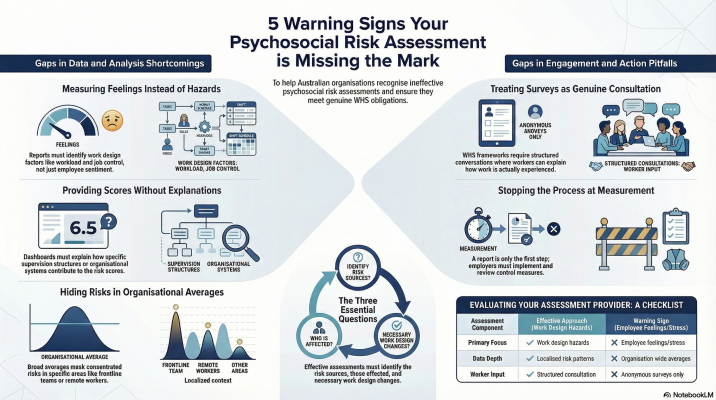
1. The results focus on feelings but not hazards
If your report tells you that employees feel stressed, disengaged or dissatisfied - but doesn't tell you what conditions of work are driving those outcomes - you don't have a psychosocial risk assessment. You have a sentiment report.
Under the WHS framework, employers need to understand hazards in the design and management of work. These include workload demands, job control, role clarity, interpersonal conflict, exposure to aggression and organisational support. Without measuring these factors directly, there is no basis for deciding which control measures are needed.
Feelings are a signal. Hazards are the problem. A good assessment identifies the problem.
2. The report produces scores but not explanations
A polished dashboard with colour-coded scores can look impressive. But if it doesn't explain why those scores look the way they do - which work processes, supervision structures or organisational systems are contributing to the risk - it offers limited value for decision-making.
A useful psychosocial risk assessment helps leadership understand how the organisation is contributing to risk. That means examining how work is actually designed and managed, not averaging survey responses across the workforce and presenting them in a chart.
Without that context, there is nothing actionable to work with.
3. The data can't identify where risks are concentrated
Psychosocial hazards are rarely distributed evenly across a workplace. Frontline teams may be exposed to aggression from the public. Project teams may experience sustained workload pressure at certain points in the cycle. Remote workers may have limited access to support.
If your results are presented only at an organisation-wide level, these patterns are invisible. And if the patterns are invisible, the controls will miss the mark.
An assessment that can't tell you where risk is concentrated can't help you target your response. Organisation-wide averages protect no one.
4. Workers were surveyed but not genuinely consulted
A survey is a data collection tool. It is not consultation.
The WHS framework is explicit: workers must be involved in identifying hazards and developing solutions. That requires structured conversations - not just anonymous tick-boxes - that give employees the opportunity to explain how work is actually experienced.
When an assessment process relies solely on a survey with no consultation component, it misses the qualitative insight that explains what the data means. It also fails to meet a core requirement of the risk management process.
If your provider delivered a survey and a report but no structured consultation, the process is incomplete.
5. The assessment stops at measurement
This is the most common failure we see.
The organisation receives a report. The report is presented to leadership. It is noted, filed and referenced in the next board update. And then nothing changes.
Under the WHS Codes, measurement is only the first step. Employers must implement control measures and review their effectiveness. The value of any assessment depends entirely on what happens after the data is collected.
A provider that delivers a report without practical guidance on how to translate findings into changes to work design, supervision practices or organisational systems has completed a transaction - not a risk management process.